
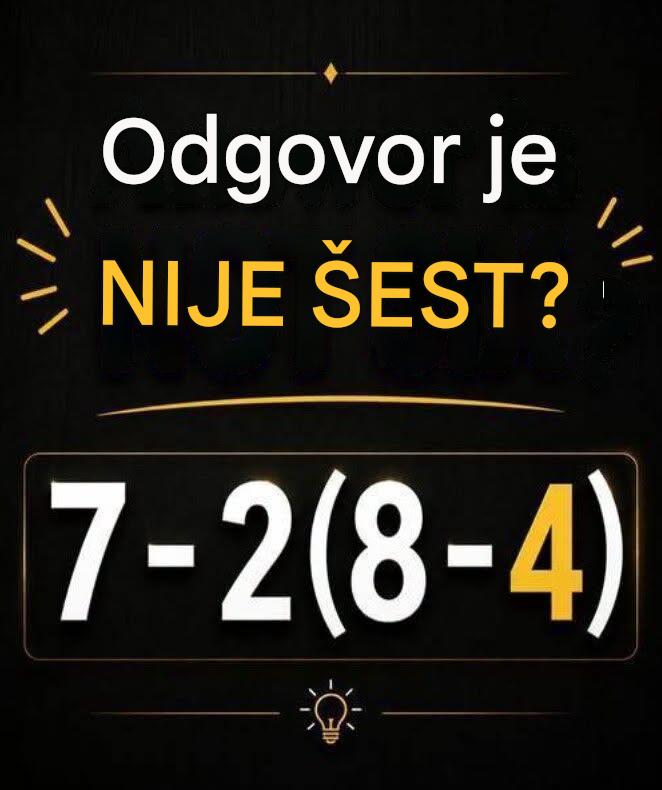
What did you get?
A. 1
B. 8
C. 16
D. 20
Make your choice before continuing.
Why Is This Problem So Confusing?
The tricky part isn’t the numbers themselves. It’s the way the equation is written.
First, you need to deal with the parentheses:
2 + 2 = 4
That leaves:
8 ÷ 2 × 4
Under the commonly taught order of operations, multiplication and division have the same priority, so they are evaluated from left to right.
That gives:
8 ÷ 2 = 4
Then:
4 × 4 = 16
So, using that convention, the answer is:
16 🎯
But here’s where things get interesting.
Some people interpret the original expression as:
8 ÷ [2(2 + 2)]
That gives:
8 ÷ 8 = 1
And that’s exactly why this equation has sparked so many debates online.
So, What’s Really Going On?
The problem isn’t necessarily that people “can’t do math.”
The bigger issue is ambiguous notation.
When an expression can reasonably be interpreted in more than one way, the safest approach is to rewrite it with clearer parentheses or a fraction bar.
For example:
8 ÷ [2(2 + 2)]
and
(8 ÷ 2)(2 + 2)
are much clearer expressions because they remove the ambiguity.
Did You Get It Right?
If you answered 16, you followed the conventional left-to-right treatment of multiplication and division.
If you answered 1, you interpreted the expression as having the entire quantity 2(2 + 2) in the denominator.
Either way, this is a great reminder that sometimes the hardest part of a math problem isn’t the calculation—it’s understanding exactly what the notation means. 🧠
So… what answer did you get? Be honest! 👇
